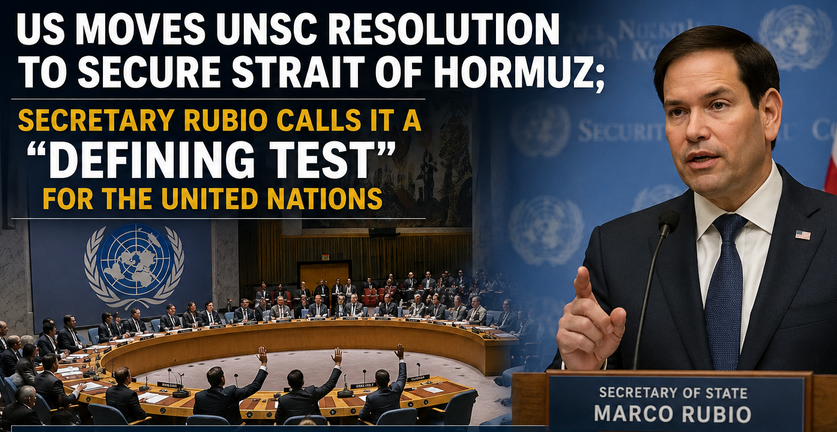
US Moves UNSC Resolution to Secure Strait of Hormuz; Secretary Rubio Calls it a “Defining Test” for the United Nations
Washington D.C. | May 6, 2026
In a high-stakes diplomatic move aimed at stabilizing global trade routes, the United States has formally proposed a draft resolution to the United Nations Security Council (UNSC). The resolution seeks to defend the freedom of navigation and secure the Strait of Hormuz, a vital maritime artery currently embroiled in a power struggle between Washington and Tehran.
Countering Iran’s “Economic Hostage” Strategy
US Secretary of State Marco Rubio issued a scathing statement on Tuesday, accusing Iran of holding the global economy hostage. He cited Tehran’s alleged attempts to block the waterway, attacks on commercial shipping, the laying of sea mines, and the imposition of illegal tolls on maritime traffic.
According to Rubio, this proposal was drafted under the direct guidance of President Donald Trump, in close coordination with key Gulf partners including Bahrain, Saudi Arabia, the United Arab Emirates, Kuwait, and Qatar.
Key Mandates of the Draft Resolution
The proposed resolution lays out a series of stringent requirements for the Iranian government:
- Immediate Cessation: Iran must stop all attacks on merchant vessels and halt the laying of sea mines.
- Transparency: Tehran is required to disclose the exact number and location of sea mines currently in the water.
- Cooperation: Iran must cooperate with international efforts to safely remove these hazards.
- Humanitarian Support: The resolution calls for the establishment of a humanitarian corridor to ensure the safe transit of essential goods.
A “Test” for Global Diplomacy
In a press briefing at the White House, Secretary Rubio emphasized that the resolution serves as a benchmark for the United Nations’ relevance.
“If the international community cannot rally behind something as straightforward as freedom of navigation, then one must ask—what is the utility of the UN system?” Rubio remarked.
The statement carries weight following a similar Bahrain-led resolution last month, which was vetoed by Russia and China. Rubio argued that it is in the best interest of Moscow and Beijing to support this new draft, warning that continued instability could trigger “economic chaos” for dozens of nations worldwide.
Background: The April Standoff
In April 2026, a previous attempt to pass a resolution regarding the Strait of Hormuz failed despite 11 out of 15 members voting in favor. China and Russia exercised their veto power, while Pakistan and Colombia abstained. The US expects a fresh vote on this updated draft in the coming days, hoping for a broader international consensus to prevent a full-scale economic disruption.
Perspective and Analysis (E-E-A-T)
This report is based on official statements from the US Department of State and White House briefings. As the Strait of Hormuz handles nearly one-fifth of the world’s daily oil consumption, the outcome of this UNSC vote is critical for global energy security and financial markets.
Disclaimer: This report is based on official diplomatic statements and current geopolitical developments. The outcome of the resolution depends on the upcoming vote in the UN Security Council and the positions taken by its permanent members.
Related News


Follow us for Latest Updates
