Rajasthan’s Financial System to Become More Transparent and Tech-Driven with IFMS 3.0; Chief Secretary Emphasizes Cyber Security and AI
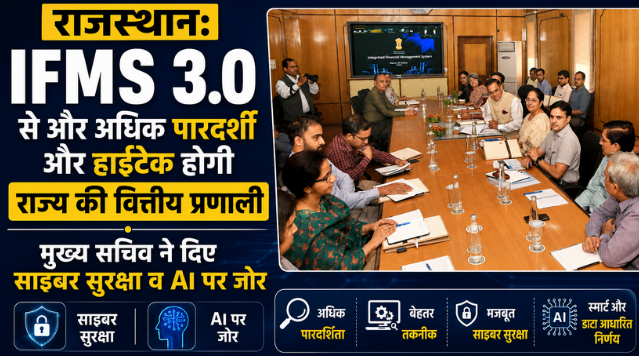
JAIPUR: In a major push toward digital transformation and accountable governance, the Rajasthan government is rapidly upgrading its financial and treasury management infrastructure. During a high-level webinar on the Integrated Financial Management System (IFMS 3.0) held at the State Secretariat on Wednesday, Chief Secretary V. Srinivas outlined the administration’s commitment to tech-driven, citizen-centric governance.
The upgraded IFMS 3.0 aims to make the state’s financial architecture more transparent, traceable, and secure.
Focus on Artificial Intelligence and User-Friendly Modules
Addressing the officials, Chief Secretary V. Srinivas directed that all modules of IFMS 3.0 must be implemented within the stipulated timeframe to realize Chief Minister Bhajanlal Sharma’s vision of ‘Good Governance’ (Sushasan). He placed special emphasis on making the platform highly user-friendly by integrating Artificial Intelligence (AI) and modern technological tools. This upgrade is expected to bring unprecedented efficiency to payment processing, scheme implementation, and overall financial monitoring.
Zero Compromise on Cyber Security
Highlighting data protection as the most critical pillar of any digital financial ecosystem, the Chief Secretary conducted a thorough review of the state’s cybersecurity measures. He issued strict directives to implement robust cybersecurity protocols, conduct regular security audits, and raise awareness against digital threats. All government departments were instructed to operate with maximum vigilance and responsibility to ensure the absolute safety and reliability of state financial data.
Capacity Building and Inter-Departmental Coordination
To ensure the smooth operation of the new system, Srinivas stressed the need for seamless coordination among various departments and the simplification of administrative processes. He advised that the best practices being adopted across different districts should be actively shared. Furthermore, he directed the organization of regular training and capacity-building programs for Drawing and Disbursing Officers (DDOs), district-level authorities, and other relevant personnel.
Rajasthan’s Financial Model Inspiring Other States
Principal Secretary of the Finance Department, Vaibhav Galriya, noted that IFMS 3.0 is a revolutionary initiative in modernizing the state’s economy. He shared that various government departments and public welfare schemes are being integrated into this digital platform in a phased manner. Specifically, systems like ‘SNA Sparsh’ are being effectively executed. Galriya also highlighted that Rajasthan’s modernized financial management model is proving so effective that several other states are currently studying it for implementation.
Key Presentations and Attendees
During the webinar, Additional Director (IFMS) Manish Shukla delivered a comprehensive presentation detailing the various modules of IFMS 3.0, including the Revenue Management System, Treasury Management, Help Desk & Support System, SNA Sparsh, and the established cybersecurity frameworks.
The crucial meeting was attended by prominent officials, including Special Secretary Finance (Budget) Shivangi Swarnkar, Joint Secretary (Treasury & Accounts) Sandhya Sharma, along with senior officers from the Budget, Finance, and NIC (IT) departments. Additionally, District Collectors, Treasury Officers, and Sub-Treasury Officers from across the state joined the session via video conferencing.
Disclaimer:
This news report is based on official press releases and information shared during the government webinar.
Related News

Follow us for Latest Updates
