Agentic AI 2026: From Answering Questions to Executing Tasks—How AI Agents are Redefining Business
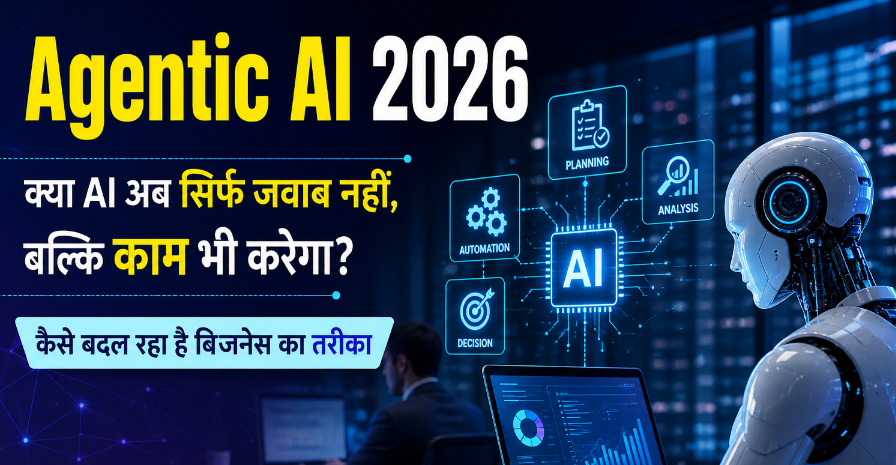
The year 2026 marks a historic “inflection point” in the evolution of Artificial Intelligence. While the previous years were dominated by Generative AI tools like ChatGPT and Gemini that primarily answered questions, we have now entered the era of Agentic AI. Today, AI is no longer just a digital librarian; it has become a digital workforce—capable of reasoning, planning, and executing complex tasks independently.
What is Agentic AI? (The Simple Breakdown)
Unlike traditional AI that requires step-by-step “prompts” for every action, Agentic AI functions as a “Smart Worker.” It doesn’t just generate text; it pursues goals.
The Core Characteristics of an AI Agent:
- Autonomous Planning: It breaks down a broad goal (e.g., “Organize a business trip to London”) into individual steps without human intervention.
- Tool Integration: It can use external software, browse the web, access APIs, and interact with databases.
- Self-Correction: If an agent encounters an error (e.g., a booked-out hotel), it automatically seeks an alternative rather than stopping and asking for help.
- Multi-Agent Systems: The most advanced form involves multiple specialized agents—one for research, one for analysis, and one for execution—collaborating to solve complex problems.
The State of Agentic AI in 2026: By the Numbers
Global industry leaders have shifted their focus from “pilots” to “production-scale” implementation:
- Gartner Report: By the end of 2026, 40% of enterprise applications will feature task-specific AI agents, up from less than 5% in 2025.
- Deloitte 2026 Survey: 74% of organizations expect to use AI agents extensively within the next two years. However, a significant gap remains, as only 21% of companies currently have mature governance frameworks in place.
Real-World Business Impact
Agentic AI is moving beyond the “hype” into high-value use cases:
- Customer Operations: Agents now handle end-to-end support tickets, including processing refunds and navigating complex troubleshooting, rather than just providing scripted answers.
- Software Engineering: AI agents are writing, testing, and deploying code. They can identify bugs in real-time and push fixes independently.
- Supply Chain: Real-time inventory management and automated vendor negotiations are now standard in top-tier logistics firms.
- The India Context: Indian IT services and the BFSI (Banking, Financial Services, and Insurance) sector are leading global adoption. This is effectively reshaping the traditional BPO model into a more efficient, AI-driven “Outcome-as-a-Service” model.
Challenges and Reality Checks
Despite the excitement, the transition is not without risks. Gartner predicts that 40% of Agentic AI projects may fail by 2027 due to legacy system issues and poor process redesign.
Primary Risks:
- The Governance Gap: With agents taking real-world actions, the question of “who is liable for an AI mistake” remains a legal hurdle.
- Security & Hallucinations: An agent acting on “hallucinated” or false data could lead to significant financial or operational losses.
- Job Displacement vs. Creation: While routine administrative roles are being automated, new specialized roles like Agent Orchestrators and AI Ethics Officers are emerging.
Future Outlook (2027-2028)
The next frontier is Physical AI, where these digital agents will be integrated into robotic hardware. For now, the organizations that will lead the market are those that prioritize Governance, Human-AI Collaboration, and Scalable Infrastructure.
Disclaimer: This article is for informational purposes only and is based on analysis of 2026 industry reports from Gartner, Deloitte, and Salesforce. Organizations should consult with technical and legal experts before implementing autonomous AI systems.
Related News



Follow us for Latest Updates
