When System Fails the Poor: Tribal Man Brings Sister’s Skeleton to Bank, Bhim Army Chief Speaks Out
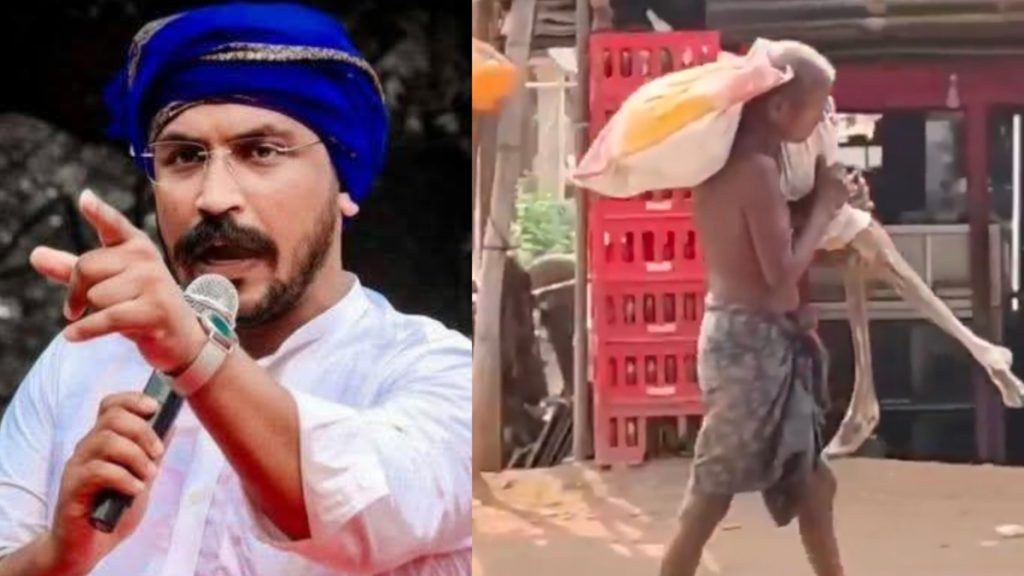
A deeply disturbing incident from Keonjhar district in Odisha has drawn national attention. A tribal man was forced to carry the skeletal remains of his deceased sister to a bank just to access her savings. The episode highlights not only personal helplessness but also the harsh reality of bureaucratic rigidity and systemic insensitivity faced by marginalized communities.
What Happened?
Jeetu Munda, a resident of Keonjhar district, wanted to withdraw ₹19,300 from his late sister’s bank account. His sister had passed away around three months earlier, on January 26, 2026.
The family had already suffered immense loss. His sister’s husband and only child had died earlier, leaving her alone. After her death, Jeetu Munda remained the only surviving member of the immediate family.
When he approached the bank to withdraw the money, officials asked him to submit a death certificate and legal heir (succession) documents. Due to the absence of these documents, he was reportedly sent back multiple times, with officials citing “rules and procedures.”
A Desperate and Shocking Step
After repeated rejections, Jeetu Munda took an extreme and heartbreaking step.
He went to the cremation ground, dug up his sister’s grave, and took out her skeletal remains. Wrapping the bones in cloth, he carried them on his shoulder and walked nearly 5 kilometers barefoot to the bank.
The scene inside the bank left everyone shocked. It was not just an act of protest, but a painful expression of the struggles faced by a poor and helpless individual trying to prove a basic fact—his sister’s death.
The Reality of Documentation Barriers
This incident raises a critical question: how accessible are essential documents for the poor?
Obtaining documents like death certificates and legal heir certificates can be a lengthy and complex process, especially in rural areas. Allegations often point to delays and systemic hurdles, making it extremely difficult for economically weaker and tribal individuals to complete formalities within a short time.
For someone in Jeetu Munda’s position—poor and from a tribal background—arranging such documents quickly becomes nearly impossible.
A Larger Question: Unequal Systems
The incident also brings attention to a broader disparity.
On one hand, ordinary citizens struggle to access small amounts of their own money due to procedural barriers. On the other hand, there are frequent discussions about large-scale loan waivers benefiting wealthy industrialists.
This contrast raises serious concerns about inequality and the functioning of systems that appear to impact different sections of society in vastly different ways.
Statement by Bhim Army Chief Chandrashekhar Azad
Bhim Army chief Chandrashekhar Azad reacted to the incident, stating:
“In Keonjhar district of Odisha, Jeetu Munda is seen carrying the skeleton of his sister, who died three months ago (on January 26, 2026), after exhuming it from her grave. His sister had already lost her husband and only child, and now he is the only surviving member of the family.
To withdraw ₹19,300 from his sister’s bank account, he was repeatedly turned away by bank officials for not being able to produce a death certificate and legal heir documents, with officials citing ‘rules.’
Frustrated, he went to the cremation ground, dug up his sister’s grave, and brought out her skeleton. Wrapping it in cloth, he carried it on his shoulder and walked 5 kilometers barefoot straight into the bank.
The level of corruption is such that obtaining these certificates in a short time without influence or payment is nearly impossible. And being both poor and tribal, it was even harder for him to arrange these documents quickly.
Meanwhile, in the same banking system, loans worth lakhs of crores belonging to industrialists are quietly written off, allowing them to build massive wealth.
This incident from Odisha exposes the brutal truth of systemic insensitivity and inequality.”
Conclusion
This is not just an isolated incident—it reflects deeper structural issues within administrative and financial systems. While rules are necessary, their implementation without empathy can lead to extreme and tragic situations.
A more humane, accessible, and responsive system is essential to ensure that no individual is pushed to such desperate measures simply to claim what is rightfully theirs.
Related News



Follow us for Latest Updates
