Middle East Crisis: Drone Strike Targets UAE Nuclear Power Plant; Air Defenses Intercept Two Drones as US-Israel-Iran Conflict Remains Deadlocked
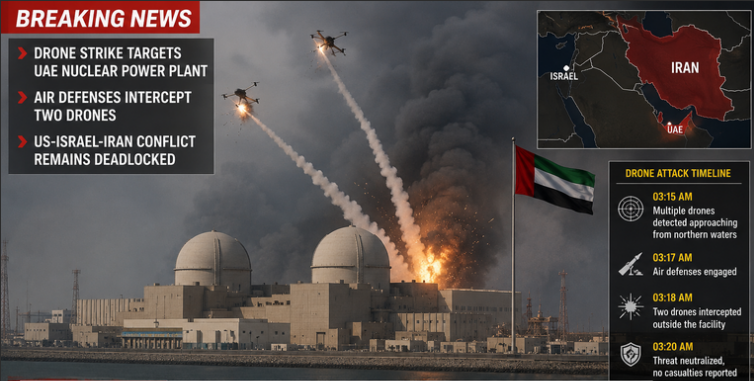
Amid ongoing military hostilities and deep diplomatic stagnation between the United States, Israel, and Iran, a highly alarming development has emerged from the Gulf region. Officials in the United Arab Emirates (UAE) confirmed on Sunday that the country’s strategically vital Barakah Nuclear Power Plant was the target of a deliberate drone attack. According to the UAE Ministry of Defence, air defense networks tracked three hostile drones entering national airspace from the western border. Two of the drones were successfully intercepted and destroyed mid-air, while a third managed to breach the outer perimeter.
Radiological Safety Unaffected; IAEA Monitors Situation closely
According to an official directive released by the Abu Dhabi Media Office, the rogue drone impacted an electrical generator situated outside the inner security perimeter of the Al Dhafra-based nuclear facility, igniting a localized fire. Authorities confirmed there were no casualties or physical injuries reported from the site. Crucially, environmental monitoring teams confirmed that radiological safety levels within and around the facility remain completely stable and unaffected.
Reacting to the incident, the International Atomic Energy Agency (IAEA) issued a statement noting that emergency diesel backup generators were immediately deployed to sustain uninterrupted power to the plant’s ‘Unit 3’. Highlighting the systemic risks associated with combat operations near atomic infrastructure, the IAEA called for “maximum military restraint” from all state actors and stated it is monitoring the situation with the highest level of scrutiny.
A Tenuous Ceasefire Devastated by Diplomatic Deadlock
The conflict, which erupted following coordinated US and Israeli airstrikes against Iran on February 28, 2026, had been held in check for the past five weeks by a fragile ceasefire. However, regional stability was severely upended following US President Donald Trump’s announcement of a specialized naval mission aimed at breaking Iran’s operational blockade over the Strait of Hormuz—the world’s most critical transit artery for maritime oil and gas shipments. Following the announcement, Iran dramatically amplified its asymmetrical strikes against commercial infrastructure and Gulf nations hosting US military installations.
Irreconcilable Geopolitical Directives:
- The Washington Mandate: The United States has demanded that Tehran completely dismantle its domestic nuclear program and permanently relinquish its enforcement grip over the Strait of Hormuz. President Trump has issued explicit warnings that full-scale kinetic strikes will resume immediately if Iran rejects a comprehensive structural deal.
- The Tehran Counter-Position: Iran has conditioned any cessation of hostilities on receiving state-level war reparations, an absolute lifting of the US naval blockade on Iranian ports, and an immediate halt to Israeli operations across all regional fronts, including Lebanon. Abolfazl Shekarchi, a senior spokesperson for the Iranian armed forces, issued a harsh rejoinder on Sunday, warning that if US threats materialize, Washington will face “aggressive and surprise scenarios.”
Global Energy Impact and Tactical Readiness
The ongoing maritime gridlock through the Strait of Hormuz has triggered the most severe oil supply crisis in modern economic history, driving global crude prices to unprecedented thresholds. Ebrahim Azizi, head of the Iranian parliament’s national security committee, indicated that Tehran will soon unveil a unilateral regulatory mechanism to manage all maritime traffic through designated channels in the strait.
Meanwhile, the UAE Ministry of Defence stated that its armed forces remain on full alert to counter any escalation. Emirati officials emphasized that they reserve the full sovereign right to respond appropriately to these “terrorist actions” once the ongoing investigation definitively establishes the geographical origin of the launch.
Disclaimer: This geopolitical dispatch is formulated based on preliminary state-level briefs issued by the UAE Ministry of Defence, the Abu Dhabi Media Office, and official transcripts from the International Atomic Energy Agency (IAEA) on May 17, 2026. Given the fluid nature of regional conflicts and strategic security operations, operational details and diplomatic positions are subject to rapid transformation. For validated international security directives, readers should consult official releases from the United Nations Security Council or respective national ministries of foreign affairs.
To read this news in Hindi, click here: missionkiawaaz.in
Related News


Follow us for Latest Updates
