Historic Yamuna Water Agreement: Shekhawati’s Thirst to be Quenched, Crucial Pact Signed Between Rajasthan and Haryana
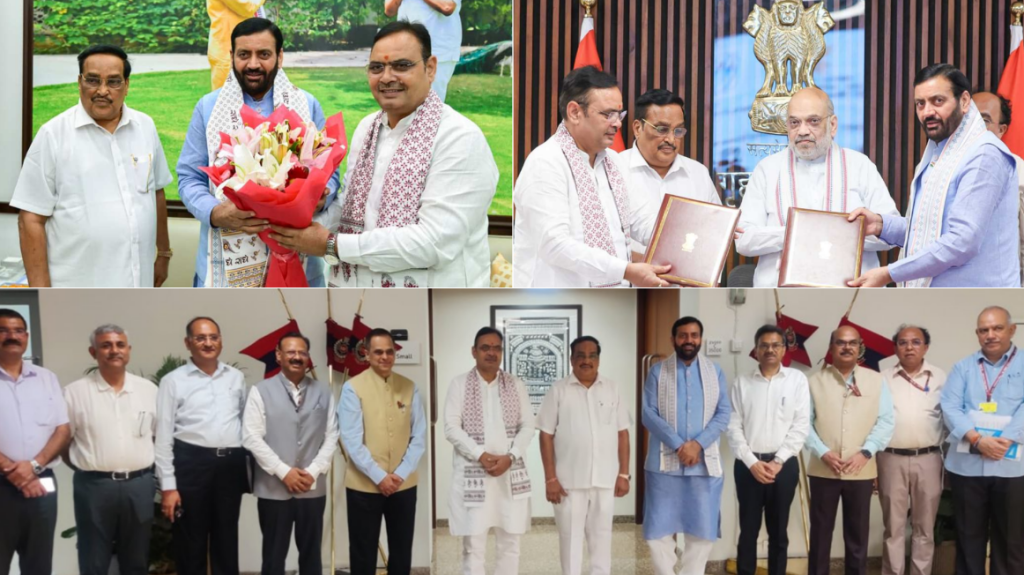
June 29, 2026, marks a historic day for the Shekhawati region (Churu, Sikar, and Jhunjhunu) of Rajasthan. The path to bringing Yamuna water to this parched region, which has suffered from water scarcity for decades, has finally been cleared. A Memorandum of Agreement (MoA) regarding the Yamuna Water Project was signed between Rajasthan and Haryana at Kartavya Bhavan in New Delhi, under the chairmanship of Union Home Minister and Minister of Cooperation, Amit Shah.
₹34,102 Crore Project: 295 km Long Pipeline to be Laid
The estimated cost of this massive inter-state water project is approximately ₹34,102 crore. Under the agreement, a 295.5-kilometer-long underground pipeline will be laid from the Hathnikund Barrage in Haryana to the Hansiyawas reservoir in Rajasthan’s Churu district. The project encompasses the development of three underground pipelines, an inspection road, artificial reservoirs, and a modern water management system.
The Rajasthan government has already submitted the Detailed Project Report (DPR) to the Central Water Commission (CWC). Concurrently, the Haryana government has granted in-principle approval for the pipeline alignment. For the construction, operation, and maintenance of the project, a dedicated entity named the ‘Rajasthan Haryana Yamuna Water SPV (Special Purpose Vehicle)’ will be constituted.
An Excellent Example of Cooperative Federalism: Amit Shah
During the signing of the MoA, Union Home Minister Amit Shah described it as an outstanding example of Prime Minister Narendra Modi’s mantra of ‘Cooperative Federalism.’ He stated that this agreement provides a permanent resolution to the nearly three-decade-old drinking water problem shared by Rajasthan and Haryana. Shah emphasized that the agreement incorporates a scientifically rigorous monitoring mechanism for cost-sharing, water allocation, and maintenance, ensuring it remains a dispute-free model for decades to come.
Achievement Made Possible by the ‘Double Engine’ Government: CM Bhajanlal Sharma
Rajasthan Chief Minister Bhajanlal Sharma expressed his profound gratitude to Prime Minister Narendra Modi and Home Minister Amit Shah for facilitating this historic milestone. He noted that despite the Upper Yamuna Basin Agreement in 1994, Rajasthan could not utilize its allocated share of 1,917 cusecs of water due to the lack of a proper conveyance system.
Attributing this success to the power of a “double-engine government,” CM Sharma remarked, “Double engine means taking decisions without delay and executing them without obstacles.” He highlighted that this pipeline would not only benefit Shekhawati but also provide drinking water to 10 locations in Haryana. Furthermore, the Hansiyawas reservoir will mutually benefit the residents of Haryana.
Haryana Will Provide Full Cooperation: Nayab Singh Saini
Haryana Chief Minister Nayab Singh Saini assured complete cooperation in the execution of this project. He stated that excess rainwater would be transported to Rajasthan through the pipeline, fulfilling the collective responsibility of ensuring access to clean water for every individual.
The Signatories: This historic MoA was formally signed by the Union Minister of Jal Shakti C.R. Patil, Rajasthan Chief Minister Bhajanlal Sharma, and Haryana Chief Minister Nayab Singh Saini. The Chief Secretaries and senior officials of both states were also present to witness the occasion.
Conclusion: The Yamuna Water Agreement has emerged as an ideal model for resolving inter-state water disputes and managing shared natural resources. Its realization will secure the drinking water future of Rajasthan’s arid Shekhawati region while simultaneously paving the way for the phased expansion of irrigation facilities.
Related News

Follow us for Latest Updates
