Yamuna Water Agreement Sealed: CM Bhajanlal’s Key Delhi Meet Paves Way for Shekhawati Pipeline
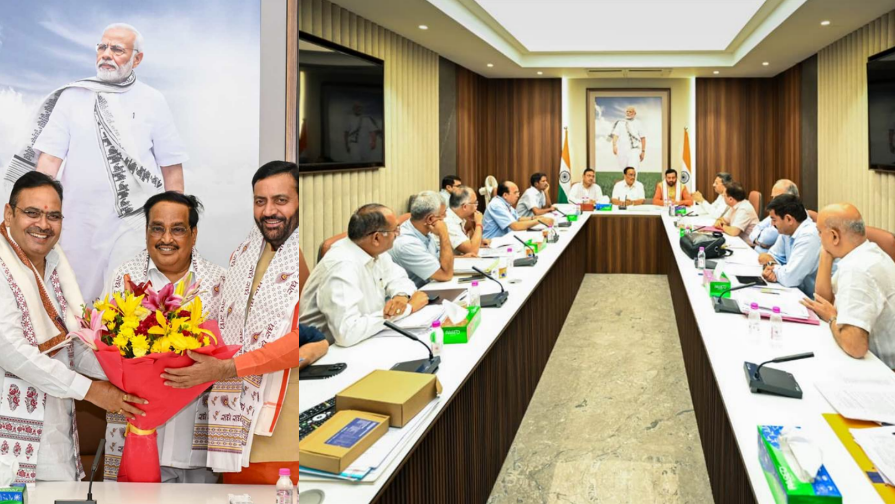
New Delhi. A long-standing water crisis in Rajasthan’s Shekhawati region and adjacent areas is close to a permanent resolution. In a decisive move to ground the decades-old ‘Yamuna Water Project’, a high-level review meeting was convened in New Delhi on Tuesday. The crucial tripartite talks saw the participation of Rajasthan Chief Minister Bhajanlal Sharma, Union Minister for Jal Shakti C.R. Patil, and Haryana Chief Minister Nayab Singh Saini.
The meeting involved extensive deliberations on the technical, logistical, and administrative facets of the water distribution network. In a landmark breakthrough, the leaders successfully finalized the key components of the Memorandum of Agreement (MOA), effectively clearing the hurdles for Rajasthan to access its designated water share.
Aligning with Prime Minister Narendra Modi’s vision of ‘Water is the Future’, the joint initiative emphasizes inter-state coordination and advanced water resource management to tackle regional scarcity.
Underground Pipeline to Replace Traditional Canals
Union Jal Shakti Minister C.R. Patil emphasized that water conservation remains the core priority of this project. Consequently, the layout proposes transporting Yamuna water to Rajasthan through an advanced underground pipeline network instead of traditional open canal systems. This modern infrastructure will eliminate water loss caused by evaporation and seepage, ensuring a highly efficient, secure, and widespread distribution mechanism.
A Lifeline for the Shekhawati Region: CM Bhajanlal
Presenting the state’s perspective, Chief Minister Bhajanlal Sharma stated that the Yamuna Water Project serves as a vital lifeline for millions of residents in Rajasthan, particularly across the Shekhawati belt. Beyond resolving acute drinking water shortages, the project will guarantee adequate water for agricultural irrigation, fundamentally upgrading the socio-economic landscape of the region.
The Chief Minister reiterated that the state administration remains fully committed to executing the project rapidly in coordination with the Central and Haryana governments. He added that the influx of water will boost local industries and accelerate the state’s overall growth trajectory.
Inter-State Benefits: Kishau, Renuka, and Lakhwar Projects
Beyond the Yamuna consensus, the meeting marked positive progress on the Kishau Dam Project. The Union Minister announced that disputes involving six states regarding this multi-purpose dam have been resolved, and an MOA will be signed shortly to benefit Rajasthan, Delhi, and Haryana.
Concurrently, Haryana Chief Minister Nayab Singh Saini affirmed that state governments are working collectively under central guidance to fortify water security. He noted that the operationalization of the Renuka, Lakhwar, and Kishau projects will collectively benefit the populace of all three states. Furthermore, the leaders discussed technical strategies to harvest excess monsoon rainwater and redirect it to parched areas of Rajasthan.
Conclusion
The high-level consensus reached in New Delhi marks a historic turning point for water management in Rajasthan. Finalizing the Memorandum of Agreement (MOA) guarantees that Yamuna water will soon flow into the state via an eco-friendly pipeline network. This collaborative diplomatic success is poised to mitigate the state’s water vulnerabilities significantly, reinforcing its contribution toward the national ‘Viksit Bharat-2047’ objectives. The meeting concluded with senior bureaucrats from the Central Government, Rajasthan’s Water Resources Department, and the Haryana government outlining the immediate execution steps.
Related News

Follow us for Latest Updates
