Fish Photo Row Turns Political: Full Story of Viral Image, Clarification, and Counterattacks
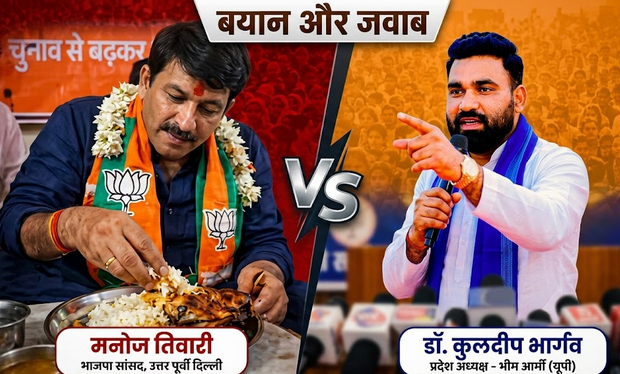
A controversy that began with a viral photo has now snowballed into a mix of politics, satire, and concerns about digital misinformation. The image allegedly showing Manoj Tiwari eating fish triggered widespread reactions online. His clarification, followed by sharp remarks from Kirti Azad and a sarcastic response from Dr. Kuldeep Bhargav, has pushed the issue into the national spotlight.
How It Started: One Image, Many Questions
The controversy began when a photo circulated widely on social media, appearing to show Manoj Tiwari eating fish. The image quickly went viral, prompting users to question his stance and past public image.
Some critics framed it as hypocrisy, while others dismissed it as a personal choice being unnecessarily politicized. However, the situation escalated when Tiwari himself responded to the claims.
Manoj Tiwari’s Clarification: “Misleading, Edited, or AI-Generated”
Responding to the backlash, Manoj Tiwari stated that the viral images were not authentic. According to him:
- The photos are either edited or created using AI tools
- They are being circulated to damage his public image
- Political opponents are spreading such content due to a lack of real issues
He also urged people not to believe everything they see online without verification, highlighting the growing problem of manipulated content.
Kirti Azad’s Reaction: Sharp Political Criticism
The controversy intensified when Kirti Azad joined the debate. He shared the image on social media and took a dig at Tiwari’s alleged “satvik fish” remark.
His comments were direct and critical, signaling that this was more than casual trolling—it had turned into a political confrontation. His remarks further fueled the debate, drawing reactions from both supporters and critics.
Bhim Army’s Response: Satire with a Message
Adding another layer to the controversy, Bhim Army leader Dr. Kuldeep Bhargav responded with sarcasm. Referring to the claims around fish being “satvik,” he made a pointed remark suggesting different “types” of fish in different regions.
This response was widely seen as a critique of the logic used in the original defense. It also reflected how opposition voices often use satire to challenge political narratives.
Social Media’s Role: Amplifier of Conflict
Social media played a crucial role in turning this issue into a major talking point:
- Memes and jokes flooded platforms like X (formerly Twitter)
- Users interpreted the issue through political biases
- The line between fact and satire became increasingly blurred
What started as a single image soon evolved into a broader online trend involving humor, criticism, and political messaging.
The Bigger Picture: Politics, Image, and the Digital Age
Looking beyond the immediate controversy, this incident highlights three key aspects:
1. Politics in Everyday Narratives
Even a simple image can become a political tool. Public figures are constantly under scrutiny, and any content related to them can be used to shape narratives.
2. Rise of AI and Fake Content
If the claims about edited or AI-generated images are true, it underscores the growing challenge of digital misinformation. It is becoming increasingly difficult for the average user to distinguish between real and manipulated content.
3. Food and Identity
In India, food is not just a personal preference—it is closely tied to culture, identity, and sometimes politics. Debates around vegetarian and non-vegetarian food often carry deeper social and ideological undertones.
Conclusion
The Manoj Tiwari fish photo controversy is no longer just about a viral image. It has evolved into a broader discussion involving political narratives, digital manipulation, and public perception.
On one side, there are claims of misinformation and image damage. On the other, sharp political criticism and satire. In between lies the powerful influence of social media, where information spreads rapidly—often without verification.
This episode serves as a reminder that in the digital age, understanding the difference between reality and constructed narratives is more important than ever.
Related News


Follow us for Latest Updates
