33% Political Reservation for Women: Why Does the Impasse Continue After 30 Years?
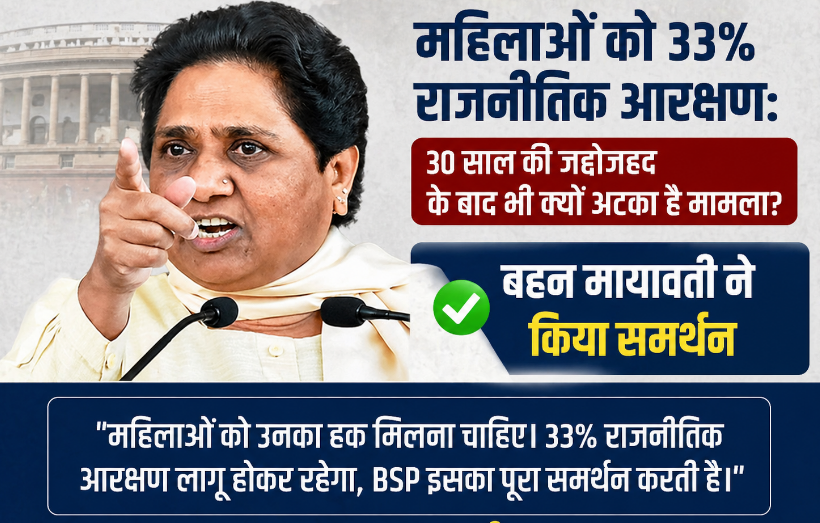
The struggle to grant women their rightful share in the democratic framework of India has been echoing through the corridors of Parliament for over three decades. While the passage of the Nari Shakti Vandan Adhiniyam 2023 was hailed as a landmark achievement, the actual implementation of the law remains entangled in technical and constitutional complexities.
Against this backdrop, a special session of the Uttar Pradesh Legislative Assembly was convened on April 30, 2026, reigniting the debate over gender representation in politics. Bahujan Samaj Party (BSP) President Mayawati has welcomed the move while highlighting the “painful delay” in transforming this bill into reality.
The Core of the Contention: Why the Delay?
The Women’s Reservation Bill aims to reserve 33% (one-third) of seats in the Lok Sabha and State Legislative Assemblies for women. However, the implementation is legally tied to two major prerequisites:
- Fresh Census: The completion of the nationwide census, which was delayed due to various factors.
- Delimitation: The reorganization of constituency boundaries based on the new census data.
In early 2026, attempts to fast-track the constitutional amendment to ensure implementation before the 2029 General Elections faced hurdles in the Lok Sabha, where the required two-thirds majority remained elusive.
BSP Chief Mayawati’s Stance: “Justice Delayed is Justice Denied”
BSP Supremo Mayawati took to social media (X) to express her concerns, labeling the continued delay as “extremely sad, unfortunate, and deeply worrying.” Her position reflects a mix of support and a demand for deeper social inclusivity:
- Support for the Special Session: The BSP officially welcomed the special session of the UP Assembly dedicated to this cause.
- Quota Within Quota: Mayawati remains steadfast in her demand that the 33% reservation must include a sub-quota for SC, ST, and OBC women. She argues that without this, the benefit will not reach the most marginalized and oppressed sections of society.
- Demand for 50%: Reflecting the actual population demographics, the BSP has historically advocated for increasing the reservation limit to 50%.
“Despite a long struggle, the matter of giving women their due participation in politics has not moved forward. The BSP supports the reservation but insists it must be implemented immediately and with social justice.” — Mayawati, National President (BSP)
The Reality of Representation
Currently, women’s participation in Indian politics lags significantly behind global averages:
- Lok Sabha: Representation of women MPs hovers around 14-15%.
- State Assemblies: In many states, this figure drops below 10%.
Experts argue that increasing women’s presence in policy-making is not just about equity; it is essential for more sensitive and effective legislation regarding education, maternal health, safety, and economic empowerment.
Challenges and Political Deadlock
The road to 33% reservation faces three primary challenges:
- The OBC Factor: Several regional parties insist on a separate quota for OBC women, leading to a lack of total political consensus.
- Regional Concerns: Southern states have expressed anxiety that delimitation based on population might lead to a decrease in their political weightage compared to northern states.
- Legislative Hurdles: Securing a supermajority in both houses of Parliament remains a significant hurdle for any ruling dispensation.
Conclusion
The Women’s Reservation Bill is more than just a seat-sharing arrangement; it is a vital step toward making Indian democracy more inclusive and balanced. The 30-year wait has been long enough. While the support from parties like the BSP is a positive sign, the focus must shift from political rhetoric to constitutional action. Implementing this before the 2029 elections would be a true testament to India’s commitment to “Nari Shakti” (Women Power).
Disclaimer: This article is based on current political developments and public statements. It is intended for informational purposes. Readers are encouraged to follow official government notifications for legal updates.
Related News
Follow us for Latest Updates
