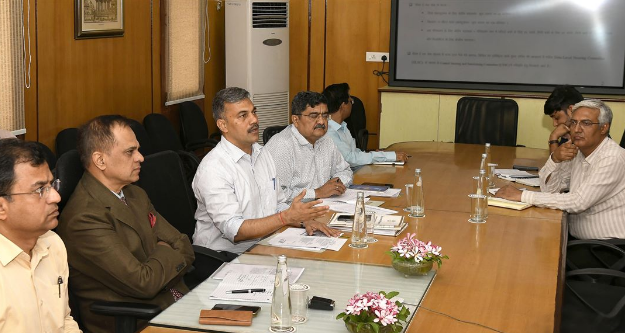
JAIPUR: In a decisive move toward establishing an eco-friendly, modern, and sustainable public transit framework across urban landscapes, the Rajasthan state government has fast-tracked its administrative machinery. Under the ambitious guidelines of the Central Government’s ‘Pradhan Mantri E-Bus Seva Scheme’, a high-level review meeting was convened at the State Secretariat on Thursday, June 4, 2026. The second meeting of the State Level Steering Committee was chaired by Rajasthan Chief Secretary Shri V. Srinivas to evaluate the project’s layout, financial allocations, and inter-departmental operations.
The extensive administrative review established a comprehensive roadmap for rolling out a massive fleet of 1,150 cutting-edge electric buses across pre-selected urban zones. The steering committee focused on creating robust ground-level infrastructure, clearing critical financial approvals, and establishing seamless synergy among various state departments to avoid operational delays.
Strategic Focus on Power Grid Scaling and Depot Infrastructure
During the session, Chief Secretary Shri V. Srinivas emphasized that the timely deployment of electric vehicles is heavily contingent upon the strength of the foundational infrastructure on the ground. He explicitly instructed officials to prioritize the modernization of existing transit hubs into fully equipped e-bus depots.
A significant portion of the discussion centered on setting up high-capacity charging stations and advancing ‘Behind the Meter Power Infrastructure’ to support heavy grid requirements without disrupting local power distribution. The Chief Secretary directed all participating departments to operate on a strict, time-bound schedule and proactively resolve any administrative or technical bottlenecks that could slow down the execution of the green transit project.
City-Wise Allocation Matrix: Distribution of the 1,150 E-Bus Fleet
To optimize urban mobility and address varying traffic densities across Rajasthan’s prominent administrative, industrial, and tourism hubs, the committee reviewed the specific allocation matrix. The 1,150 electric buses have been strategically distributed based on population demands and existing public transit gaps:
| Designated City / Urban Cluster | Total Allocated E-Buses | Current Operational Status |
| Jaipur (State Capital) | 450 Buses | Preliminary trial runs completed; charging grid deployment underway. |
| Jodhpur & Bikaner | 125 Buses Each | Depot modernization initiated; site mapping finalized. |
| Ajmer, Alwar & Kota | 100 Buses Each | Civil works for charging points active; route planning underway. |
| Udaipur, Sikar & Bhilwara | 50 Buses Each | Initial trial benchmarks verified; feeder route integration active. |
Project Update: Senior officials from the Transport Department confirmed that the initial trial runs for these electric buses have yielded successful performance metrics. Civil engineering groups are currently working at an accelerated pace to complete charging stations and upgrade structural amenities at the local maintenance depots.
Inter-Departmental Synergy and Unified Execution
The successful execution of this mega-transportation project relies on the coordinated efforts of multiple government bodies. The high-level meeting saw active participation from senior bureaucrats and representatives of the Department of Transport, Department of Finance, Department of Local Self Government (LSG), Department of Energy, and the Jaipur City Transport Services Limited (JCTSL).
Reflecting on the state’s preparedness, Additional Chief Secretary of the Urban Development and Housing (UDH) Department, Shri Alok Gupta, noted that the state is continuously expanding its technical framework to support clean energy vehicles. Concurrently, Secretary of the Local Self Government Department, Shri Ravi Jain, assured the steering committee that municipal bodies are taking all necessary institutional measures to execute the scheme effectively, ensuring that urban commuters can transition to these modern facilities in the near future.
Once fully operational, this macro-level transit upgrade is expected to drastically lower carbon emissions, reduce urban noise pollution, and offer citizens a safe, comfortable, and affordable daily commuting alternative.
Disclaimer:
This comprehensive news report is compiled based on official data, statistical figures, and administrative outlines released during the State Level Steering Committee meeting held at the Government Secretariat in Jaipur. The information is intended for public awareness regarding state transit policies. Actual dates of commercial deployment, specific route mappings, and ticketing structures remain subject to final executive adjustments by the transport authorities.
