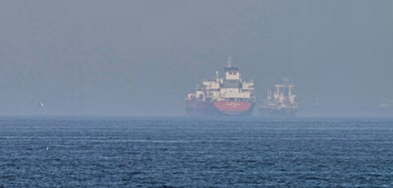
Seoul/Dubai: The security dynamics of the Strait of Hormuz have taken a volatile turn following the confirmed strike on a South Korean-operated cargo vessel, the Namu. On Sunday, a high-level government investigation revealed that the ship was struck by two “unidentified flying objects” (UFOs) last Monday, causing significant damage and igniting a fire. This development is expected to serve as a pivotal turning point for Seoul, providing the necessary grounds to reconsider its long-standing caution regarding joining U.S.-led maritime security operations in the region.
The Attack on MV Namu: Investigation Findings
The Panama-flagged cargo vessel Namu, operated by the prominent South Korean shipping firm HMM Co., was navigating the strategic Strait of Hormuz when it suffered a sudden explosion. Following the incident, the ship was towed to a port in Dubai, where a seven-member South Korean government investigation team conducted an on-site inspection.
The findings are alarming: a 7-meter-wide rupture was discovered in the vessel’s hull, caused by two consecutive strikes from unidentified flying objects. While the South Korean Foreign Ministry has refrained from naming a specific culprit or identifying the exact model of the objects, the scale of the damage indicates a sophisticated attack. Miraculously, all 24 crew members, including six South Korean nationals, escaped without injuries. However, the psychological and logistical impact of the attack has sent ripples through the international maritime community.
The U.S. Factor and Geopolitical Pressure
The Strait of Hormuz remains the world’s most critical maritime chokepoint for global energy supplies. Any disruption here poses a direct threat to the global economy. In the immediate aftermath of the explosion, U.S. President Donald Trump pointed the finger at Iran, claiming it had “taken some shots” at the vessel. The Trump administration has intensified its pressure on Seoul, arguing that it is time for major energy-importing nations like South Korea to contribute directly to the safety of international sea lanes.
Until now, South Korea has maintained a low profile concerning the U.S.-proposed ‘Maritime Freedom Construct’ (MFC). This initiative aims to enhance security through information sharing, diplomatic coordination, and military presence. Seoul’s reluctance stemmed from a desire to maintain a balanced relationship with Middle Eastern nations and avoid being drawn into a direct military confrontation. However, the strike on its own asset has effectively removed the option of neutrality.
Strategic Options for Seoul: The Cheonghae Unit
Foreign Ministry spokesperson Park Il stated that the government is pursuing “every possible measure” to prevent a recurrence, including close cooperation with the international community. He confirmed that a “close review is under way” regarding joining the MFC.
Should Seoul decide to contribute to the mission, its involvement may initially be limited to non-combat measures. This could include:
- Intelligence Sharing: Providing real-time data on vessel movements and threats.
- Liaison Officers: Dispatching military and diplomatic representatives to the mission’s headquarters.
- Logistical Support: Assisting allied vessels in the region.
If a military deployment becomes necessary, military observers believe the most likely candidate is the Cheonghae Unit. Currently stationed in the Gulf of Aden for anti-piracy missions, this elite naval unit could be redirected or expanded to cover the Strait of Hormuz. Such a move would be a powerful symbol of South Korea’s commitment to its alliance with the U.S. and its responsibility as a global trading power.
Economic Imperatives and Energy Security
For South Korea, the security of the Strait of Hormuz is not merely a matter of foreign policy but an existential economic concern. As a nation almost entirely dependent on imported energy, a majority of its crude oil and LNG supplies pass through this narrow corridor. Any prolonged closure or increased risk premium in the strait would lead to a surge in energy costs, impacting South Korean industries and households alike.
Despite the economic necessity, the decision to join a U.S.-led military mission is fraught with domestic political hurdles. The South Korean government must navigate complex international laws, maintain its alliance with Washington, and ensure that such a move does not provoke a backlash from Tehran that could endanger other Korean assets or citizens in the region.
A Critical Turning Point in Maritime Diplomacy
The attack on the Namu marks a definitive end to Seoul’s “wait-and-see” approach. The South Korean Ministry of Defense has indicated that its final position will be reviewed based on the safety of international sea lanes, the ROK-U.S. alliance, and domestic legal procedures.
As the analysis of the strike continues, the global eyes are on Seoul. Will South Korea step up as a proactive security provider in the Middle East, or will it seek a middle path that balances its alliance with the U.S. against regional diplomatic complexities? The answer will define South Korea’s role on the global stage for years to come.
Disclaimer: This report is based on findings from the South Korean Foreign Ministry’s investigation and international news agency reports regarding the strike in the Strait of Hormuz. The information provided is for descriptive and analytical purposes. For official government policy statements or confirmed military deployment details, readers should refer to official communications from the Republic of Korea’s Ministry of National Defense and Ministry of Foreign Affairs.
Follow us on Google News for more updates: