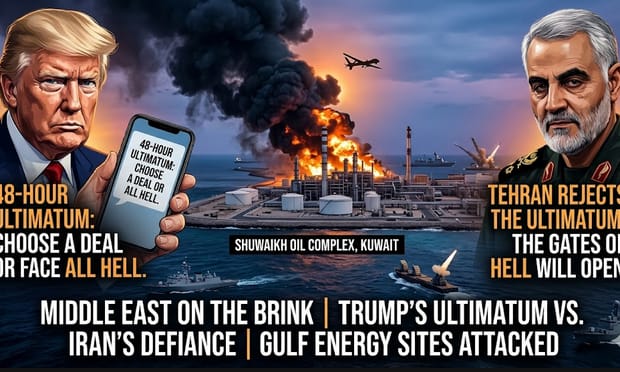
The ongoing conflict between the United States and Iran has transcended traditional battlefield boundaries, evolving into a systematic war on global energy security. The rejection of President Trump’s April 2026 ultimatum by Tehran and the subsequent strike on Kuwait’s Shuwaikh Oil Sector Complex have sent shockwaves through global markets, pushing oil prices to a critical $110 per barrel threshold.
Strategic Chokepoints and Proxy Strikes The core of the current crisis lies in the Strait of Hormuz. Since late February 2026, Iran has maintained a tight grip on this waterway, through which nearly 20% of the world’s oil supply passes. President Trump’s “48-hour deal” was a direct attempt to force the reopening of the strait under the threat of total destruction of Iran’s internal infrastructure.
However, Iran’s response has been asymmetrical. Instead of a direct naval confrontation with the U.S. Fifth Fleet, Tehran has utilized its advanced drone and missile arsenal to target the economic heart of U.S. allies in the Gulf. The fire at the Shuwaikh complex in Kuwait is not just a localized incident; it is a strategic signal. It proves that despite U.S. and Israeli claims of degrading Iranian capabilities, Tehran can still reach critical infrastructure across the Gulf.
The Human and Economic Cost The fire at Shuwaikh, though resulting in no reported injuries, highlights the vulnerability of the world’s energy supply chain. Kuwaiti authorities are struggling to secure desalination and power plants, which have also come under threat. Inside Iran, the situation is equally dire. Reports indicate that U.S. strikes on petrochemical hubs in the Khuzestan province have already resulted in civilian fatalities, fueling a cycle of retaliation that seems impossible to break.
The 48-Hour Countdown As the April 6 deadline approaches, the “energy war” is reaching its zenith. President Trump has paused strikes on Iranian power plants for a short window, but with Tehran’s military command calling his bluff, the likelihood of a massive kinetic operation increases. If the U.S. follows through on its threat to destroy Iran’s energy infrastructure, the retaliatory strikes on Gulf oil fields could lead to a global energy depression.
In this high-stakes game of chicken, the primary victims are not just the combatants, but the global economy and the millions of civilians caught in the crossfire of a 21st-century “Total War.”
