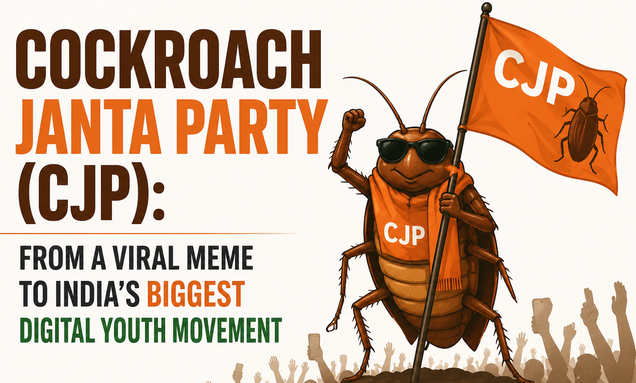
In early May 2026, the Indian social media landscape witnessed an unexpected and powerful political storm. What began as a satirical online joke under the name ‘Cockroach Janta Party’ (CJP) transformed into a massive digital movement within days. Gaining over 10 to 14 million followers on Instagram, the CJP quickly surpassed the digital footprint of the ruling party and major opposition forces. Even though its X (formerly Twitter) account was withheld in India, it became abundantly clear that CJP was no longer just a meme—it had become the definitive voice for millions of young Indians frustrated by unemployment, examination scams, and systemic failures.
1. The Spark: A Controversial Remark
The catalyst for this entire movement was a seemingly offhand remark made during a Supreme Court hearing on May 15, 2026. Chief Justice of India (CJI) Surya Kant allegedly drew a parallel between individuals holding fake degrees (in law, media, etc.) who manipulate the system, and “cockroaches.”
While it was later clarified that the CJI was not referring to ordinary unemployed youth, the damage was already done. Young Indians, already exhausted by the NEET-UG paper leaks, CBSE controversies, and soaring unemployment rates, took the remark as a personal insult. A collective sentiment quickly went viral across the internet: “If we are cockroaches, we will form our own party.”
2. The Inception: One Student and a Google Form
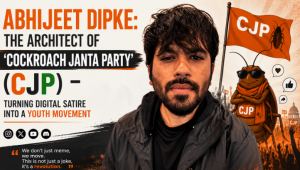
The anger found its strategic outlet on May 16, 2026, when Abhijeet Dipke, a 30-year-old Boston University student and former political social media volunteer, took to X. He asked a simple question: “What if all cockroaches come together?”
He attached a Google Form inviting people to join the ‘Cockroach Janta Party’. The eligibility criteria were hilariously relatable for the internet generation: one had to be unemployed (by force, choice, or principle), physically lazy, chronically online (11+ hours a day), and possess the ability to rant professionally.
CJP’s Unprecedented Growth:
- First 48 Hours: 40,000+ memberships.
- Within Days: Hundreds of thousands of registered members.
- Instagram Reach: Crossed 10 million followers with merely 50-54 posts.
Their official website went live with a striking tagline: “Voice of the Lazy & Unemployed.” The party headquarters? “Wherever the Wi-Fi works.”
3. The Manifesto: Serious Demands Cloaked in Satire
The CJP’s 5-point manifesto is a masterclass in blending sharp sarcasm with substantive political critique. It directly targets the everyday frustrations of the Indian youth:
- Judicial Accountability: A complete ban on post-retirement Rajya Sabha seats or government rewards for judges.
- Electoral Transparency: Arresting the Chief Election Commissioner (CEC) under UAPA if valid votes are deleted or electoral fraud occurs.
- Women’s Representation: A strict 50% reservation for women in Parliament and the Cabinet, without artificially increasing the house strength.
- Media & Corporate Monopoly: Canceling the licenses of crony-capitalist media houses and investigating the assets of biased news anchors.
- Anti-Defection Stance: A 20-year ban from contesting elections or holding public office for any MLA/MP who switches parties.
- Education & Healthcare: Demanding the Education Minister’s resignation over the NEET leaks, alongside universal free world-class education and healthcare.
Their guiding motto is unapologetic: Secular – Socialist – Democratic – Lazy.
4. Decoding the Success: Why Did CJP Resonate?
The explosive success of CJP is deeply rooted in India’s current socio-economic reality. It is a product of profound anti-establishment sentiment and systemic distrust.
- The Job Crisis: Millions of degree-holding youths are struggling to find meaningful employment.
- Broken Trust: Repeated examination scams (like NEET and UGC NET) have shattered faith in institutional meritocracy.
- A Safe Outlet: CJP provided a viral, humorous, and safe platform for the youth to vent their deep-seated anger against the system.
By turning the word ‘Cockroach’ from an insult into a badge of honor, Gen Z transformed a derogatory label into a symbol of ultimate survival and resilience.
5. Criticisms and the Road Ahead
Despite its viral success, CJP faces significant criticism and practical challenges:
- The Ground Reality: Critics argue it is merely an internet bubble with zero grassroots presence. In a country where elections are heavily influenced by caste and religious dynamics, memes do not easily convert to votes.
- Political Affiliations: The founder’s past association with political parties, coupled with the humorous backing of opposition leaders, has led to allegations of hidden political funding.
- Impractical Demands: Several manifesto points (like invoking UAPA on the CEC) are legally and constitutionally extreme.
What Lies Ahead?
In the short term, CJP might evolve into a formidable digital pressure group, focusing on youth issues, education reform, and digital conventions. If they can channel their millions of online followers into a structured grassroots organization before the 2029 general elections, it could redefine alternative politics in India.
CJP proves that Gen Z is no longer just a consumer of politics; they are active creators. As their viral slogan declares: “They tried to step on us. We came back.” The Indian political system must now decide whether to listen to these “cockroaches” or continue ignoring them.
Disclaimer: This article is an independent analysis based on publicly available news, reports, and social media trends. It does not intend to hurt the sentiments of any individual, institution, or political party. The ‘Cockroach Janta Party’ (CJP) is a satirical digital movement, and the views expressed herein reflect its online manifesto and public perception. Readers are advised to use their own discretion.
हिंदी में पढ़ने के लिए यहाँ जाएँ: (missionkiawaaz.in)