Historic Milestone in Rajasthan’s Legislative History: Governor Haribhau Bagde Unveils the New State Assembly ‘Logotype’; Officially Names 13 Structural Gates
Jaipur | May 18, 2026
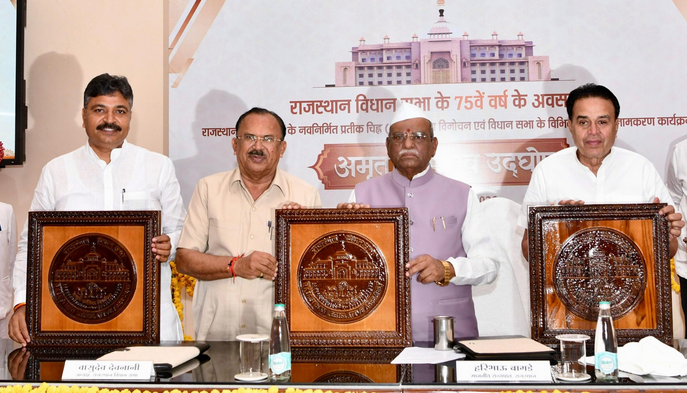
Monday, May 18, 2026, marked a monumental milestone in the democratic and legislative chronicle of Rajasthan. Commemorating the historic 75th anniversary (Amrit Mahotsav) of the Rajasthan Legislative Assembly, Honorable Governor Shri Haribhau Bagde officially unveiled the newly sculpted institutional ‘Logotype’ (emblem) of the state assembly. During the high-profile ceremony, the Governor also presided over the formal naming of 13 prominent entry gates across the legislative estate, anchoring them to Rajasthan’s legacy of valor and rich cultural consciousness.
The New Emblem: A Symbol of Rajasthani Resilience and Environmental Heritage
Addressing the assembly, Governor Haribhau Bagde stated that the legislative assembly represents the most sacred temple of democracy. He highly commended the unique initiative taken by Assembly Speaker Shri Vasudev Devnani in conceptualizing the new logo, noting that it precisely mirrors the collective philosophy and cultural landscape of the people of Rajasthan.
Core Iconography of the New Institutional Emblem:
- The Legislative Citadel: The center of the artistic emblem features a detailed architectural silhouette of the Rajasthan Legislative Assembly building.
- The Khejri Tree (The Kalpavriksha): The logo prominently integrates the ‘Khejri’ tree, Rajasthan’s official state tree. Recalling the historic Khejarli Massacre, where rural communities sacrificed their lives to protect these trees, the Governor noted that the Khejri symbolizes a deep-rooted, eco-centric ‘tree culture’ that thrives even in the harshest environments.
- The Rohida Blossom: Alongside the Khejri, the emblem incorporates the vibrant blossom of ‘Rohida’, the state flower. This pairing represents harmony, natural beauty, and the festive resilience of a society that celebrates life despite challenging geographical conditions.
Tracing Rajasthan’s Legislative Lineage Back to 1913
Delving into historical records, the Governor highlighted a critical yet often overlooked chapter of the state’s governance evolution:
Official Historical Statement by the Governor: “While the first democratically elected Legislative Assembly of independent India was formally constituted in Rajasthan in the year 1952, the foundational roots of our legislative tradition were planted long before independence. In the year 1913, Maharaja Ganga Singh of Bikaner established the ‘Prat प्रतिनिधि Sabha’ (Representative Assembly), sowing the early seeds of parliamentary systems in this region. Against the backdrop of this profound lineage, dedicating this new emblem during the era of Amrit Kaal is a matter of immense historical pride.”
The Mavalankar Anecdote: A Lesson in Conduct, Practical Education, and Management
During his keynote address, the Governor shared an inspiring historical anecdote featuring Shri Ganesh Vasudev Mavalankar, the first Speaker of India’s Lok Sabha. He recounted how Speaker Mavalankar once subtly taught a lesson in management to an economics professor who had wastefully overloaded his food plate. Shri Bagde emphasized that true leadership and social management cannot be achieved unless an individual exercises disciplined conduct in their daily personal habits.
Vision for Institutional Education and Civic Duty:
- Empowering the Underserved: The Governor called for a robust restructuring of educational management, specifically focusing on children from marginalized and economically weaker sections of society.
- Integrating Practical Learning: Stressing that a nation’s advancement is driven by the organic talent of its youth, he urged academic networks to transition from purely text-based curriculums to practical, behavioral education.
- Consciousness of Duties: Reflecting on his personal tenure as the Speaker of the Maharashtra Legislative Assembly, he underlined that democratic institutions remain strong only when citizens balance their constitutional rights with an active awareness of their civic duties.
In his closing remarks, the Governor highly praised the decision to name the 13 assembly gates after legendary historical citadels and spiritual landmarks, seamlessly weaving Rajasthan’s heritage into the daily functions of modern governance.
Disclaimer: This legislative affairs, cultural heritage, and state governance report is compiled for public informational purposes. The historical citations, emblem specifications, and executive declarations presented herein are derived from official press releases and address transcripts published by Raj Bhavan, Jaipur, and the Secretariat of the Rajasthan Legislative Assembly on May 18, 2026. For a certified list of the specific nomenclature designated for the 13 assembly gates or official assembly rules, please consult the authorized portal of the Rajasthan Legislative Assembly (assembly.rajasthan.gov.in).
To read this news in Hindi, click here: missionkiawaaz.in
Related News

Follow us for Latest Updates
