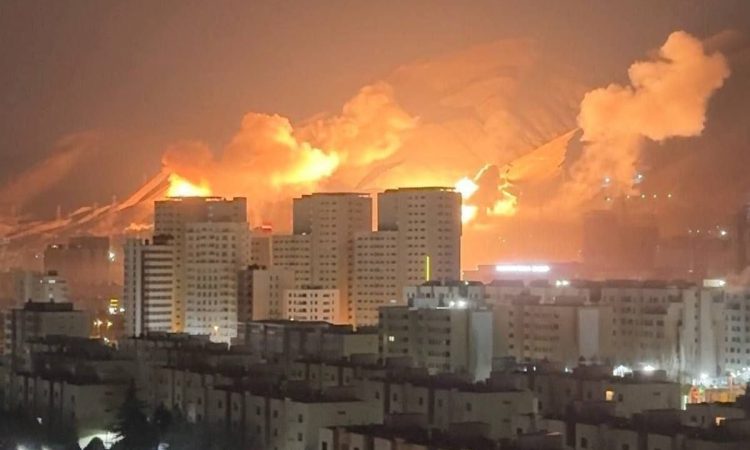
US–Israel Strikes : The situation in West Asia continues to escalate as joint air operations by the United States and Israel against Iran move into their third day. Explosions were reported in several locations, including Iran’s capital, Tehran, as the conflict shows no signs of slowing. Iran has responded with retaliatory measures, further heightening uncertainty across the region.
Israel Claims Airspace Control Over Iran
Israel’s Ambassador to India, Reuven Azar, stated that coordinated operations between Israel and the United States have established control over Iranian airspace. According to him, more than 2,500 military-related sites have been targeted so far.
Azar asserted that Israel’s defense systems have intercepted the majority of incoming missiles and drone attacks launched by Iran. He added that the objective of the ongoing military action is to weaken Iran’s offensive capabilities and ensure long-term regional stability. Expressing optimism about political developments inside Iran, he suggested that internal change in leadership remains a possibility.
Read Also –
Relief for Indian Students Stranded in Iran
Amid the volatile conditions, there has been some reassurance for Indian students currently in Iran. Saeed Reza Motallag, Iran’s Consul General in Mumbai, clarified that Indian nationals do not require special exit permits to leave the country.
With airports closed due to security concerns, students have been advised to consider land routes through neighboring countries such as Afghanistan and Turkmenistan. Authorities have indicated that carrying a valid passport will be sufficient, and assistance will be provided to facilitate their departure.
NATO Rules Out Direct Involvement
NATO Secretary General Mark Rutte confirmed that the alliance will not directly participate in the conflict. Speaking to German broadcaster ARD in Brussels, Rutte acknowledged the strategic goals of weakening Iran’s nuclear and ballistic missile capabilities but emphasized that NATO as a bloc has no plans to enter the conflict militarily.
Read Also –
He noted that while individual member states may choose to offer support independently, NATO itself will remain outside the hostilities.
France Announces Shift in Nuclear Deployment Policy
French President Emmanuel Macron unveiled a significant update to France’s nuclear posture. Under the revised strategy, France may allow temporary deployment of nuclear-capable aircraft in allied nations.
Macron clarified that although strategic air assets could be positioned in partner countries, decisions regarding the potential use of nuclear weapons would remain solely under French authority. Discussions on this arrangement have reportedly begun with the United Kingdom, Germany, Poland, the Netherlands, Belgium, Greece, Sweden, and Denmark.
A Rapidly Evolving Crisis
As military exchanges continue and diplomatic positions take shape, the situation remains fluid. Governments worldwide are closely monitoring developments, while civilians and foreign nationals in the region navigate increasing uncertainty. Further updates are expected as events unfold.
Read Also –
